| |
|
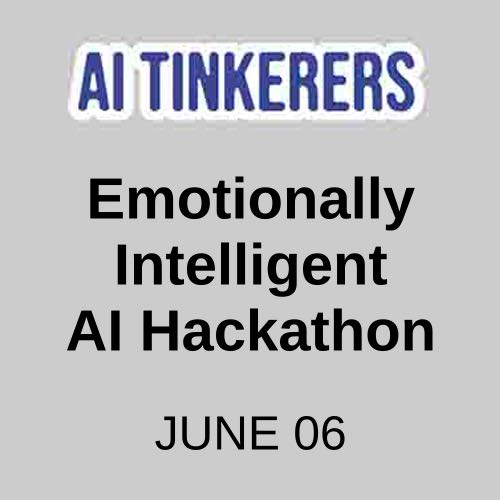
Emotionally Intelligent AI Hackathon

|
| With ElevenLabs & Tavus. Building on emotional layer for voice AI incl. detection pipelines, adaptive agents, safety rails & evaluation tools that treat emotional voice as a first-class signal. |
|
Jun 06 (Sat) @ 09:00 AM
FREE
| | Venue, To Be Announced
|
|
|
|
|
| |
| Register |
|
|
| |
AI Tinkerers presents the Emotionally Intelligent AI Hackathon, hosted in NYC with ElevenLabs & Tavus.
Voice is eating the interface. Conversational agents are replacing forms, IVRs, & chat widgets. But most of them sound like they're reading a script in a sensory deprivation chamber.
Generation quality has gotten very good. The unsolved problem is emotional intelligence. Agents that can't hear frustration, match urgency, or shift tone when someone is upset aren't agents. They're fancy hold music.
This hackathon is about building, tinkering on the emotional layer for voice AI. Not chatbots. Not TTS demos. Real systems - detection pipelines, adaptive agents, safety rails, evaluation tools - that treat emotional voice as a first-class signal.
Participants will have access to leading voice AI APIs (conversational AI, voice cloning, speech-to-text, expressive TTS) & more!
Space is limited & curated. RSVP required.
Hackathon Theme: Emotionally Intelligent Voice Systems
If every interface is becoming a voice interface, what makes it actually good at reading the room?
This weekend is about:
Agents that adapt in real-time to caller emotion - tone, pacing, word choice, escalation strategy
Detection & classification pipelines that measure emotional state from voice input across accents, languages, & contexts
Safety & guardrail systems that catch distress, escalation, or malicious intent & route accordingly
Evaluation frameworks that benchmark how well voice systems handle emotional nuance - not just word accuracy
Multilingual emotion transfer - does angry in Mandarin sound the same as angry in English? Does your system know the difference?
Creative expression systems - narrators that get nervous, game characters that react to player tone, storytellers that build tension with their voice
We're not doing chatbot wrappers.
No plug in an LLM & call it an agent. No slide decks. No hand-waving about empathetic AI.
Build a system. Make it hear something. Make it respond differently because of what it heard.
Ideas for you
1) Emotion-Aware Voice Agents
Conversational agents that detect caller emotional state in real-time & adapt their behavior. Use leading voice AI platforms + emotion-tagged data for training & evaluation. Show us an agent that handles an angry caller differently than a confused one.
2) Emotion Detection & Evaluation Pipelines
Systems that classify emotional state from raw voice input, benchmark accuracy across accents & demographics, & expose where current models break. The evaluation layer the industry is missing.
3) Voice Guardrails & Safety
Tools that detect escalation, distress, or manipulation in voice interactions - & intervene. Flag, route, pause, or hand off to a human. The safety infrastructure for voice agents at scale.
4) Multilingual Emotion Transfer
Systems that preserve emotional nuance across languages using multilingual. Build something that proves (or disproves) that emotion translates.
5) Emotional Voice Avatars
Industry-specific AI personas - healthcare, finance, hospitality - with voice profiles that convey empathy, authority, or calm. Not just what they say, but how they say it.
6) Creative Expression Engines
Storytelling, gaming, or entertainment systems that generate emotionally dynamic voice performances. A narrator that gets scared. A podcast host that reacts to audience energy. A game NPC that actually sounds upset when you betray them.
Bring a demo that works end to end. Reliability wins.
Who Is This For?
This hackathon is for builders who want to work on the emotional intelligence layer of voice AI:
Full-stack engineers
Audio & speech pipeline builders
AI/ML engineers working on voice, NLP, or affective computing
Product-minded founders building voice-first products
Creative technologists exploring expressive AI
Anyone who's shipped something with a voice API & wants to push it further
You should be able to code. You do not need to be a speech scientist.
This is fully in-person only.
No remote teams. No tourists. No spectators.
We admit 100 to 150 vetted participants.
|
|
|
|
|
|
|
|